Monday, April 18, 2011

Tuesday, April 12, 2011
Photo Gallery: Indonesian Festival brings diversity to Purdue

The annual Indonesian festival took place in St. Thomas Aquinas at 6:30 p.m. on Saturday, April 2. Presented by Indonesian Student Association at Purdue University and sponsored by the Embassy of Indonesia at Washington D.C., Indonesian festival presented both modern and traditional Indonesian cultures to Purdue students and local residents at West Lafayette.

The basement of St. Thomas Aquinas was divided into different sections for the major islands of Indonesian, as there are more than 13,000 islands in Indonesia and slightly different cultures were developed within each island. With the population of more than 136 millions, Java is the most populated island not only in Indonesia but also in the world. The capital city of Indonesia, Jakarta, is also located in west Java.
 In the room of Java island, traditional handcrafts and handmade fabrics that Indonesia is famous for were displayed on the table with explanation and stories of each item on the side.
 Music is an important everyday essential for Indonesians. For many Indonesians, playing the traditional Java instrument is their way to entertain one another and their way to show greetings to guests. Different from the western instrument like violin and piano, each instrument only has one tone. In order to play a complete song, a group of musicians playing at least 5 instruments is required.
  Another traditional entertainment of Java Island is playing puppets. Before the invention of projector and television, puppet performers played these puppets on a mini stage with only their hands shown. Most stories are based on their fairy tales and the origin of Indonesia.
In addition to Java, Indonesia has another world-known island, Bali. Well known by its beautiful white sand beaches and a complete different culture from the Java Island, Bali Island is one of the top-rated vacation places in the world. The narrow door shown in the picture is one of the very special cultural aspects of Bali. Bali people believe that people with good hearts will pass through these doors safely, while bad people will be crashed to death while attempting to enter the room.

In another room for Toraja, a distinct ethnic group of Indonesian, the traditional handcrafts made by Toraja people were displayed. With the main population found in the mountain area of South Sulawesi, Toraja people developed a very different culture from the rest of Indonesia, and they practice different religions than most Indonesians.
 Different from the Java handcrafts, most Toraja traditional handcrafts are portrays of people and Gods or Goddess' faces.
 In addition to static presentation of the cultures from each island in Indonesia, live performances were available as well. Pendet dance is a traditional Indonesian dance in which offerings are made to purify the temple or theater as a prelude to ceremonies or other dances. In Indonesia, Pendet dance is typically performed by young girls, carrying bowls of flower petals, handfuls of which are cast into the air at various times in the dance.
  Pendet dance is usually perceived as a dance of showing greetings or to welcome the audience and invite spirits to enjoy a performance.
  At the side of the room, a sample of Indonesian coffee is presented and available for guests to try. The coffee is said to have a very distinctive smell because of the soil and the way the plant grows.
 Outside of the performing room, traditional Indonesian foods were prepared for the festival guests.
  Tickets are available at the entrance. Festival guests spend $10 for 10 food coupons, which are good for exchange of $10 worth of food inside.
 According to the students serving at the food table, Es Teler is one of the most popular drinks even in Indonesia nowadays. With the combination of sliced jackfruit, palm fruit, nata de coco, mango jelly, and sago in flavored ice (syrup, sweet condensed milk, and ice), Es Teler is the "bubble tea" for young Indonesians.
 As for hot plates, Telur Balado is beyond what people outside of Indonesia can ever think of. Indonesians marinate fried hard bold eggs with ebi, shallot, garlic, lemongrass, galangal, bay leaves, and chili to make this dish. Each portion of Telur Balado costs 2 coupons at the festivals.
Asides from seeing Indonesians students from Purdue participating in the festival, many Purdue faculty members and local residents at West Lafayette attended the event as well. For people who have never been to Indonesia or who are curious of knowing more about the culture, there are tour guides available at the festival.

At the end of the festival, guests were welcomed to sign on the T-shirts of each islands. The festival came to its end at about 9:30 p.m. All guests went home with their stomachs full of Indonesian cuisines and a good memory of the night.
Tuesday, April 5, 2011
Spring Natural Montage-Purdue Main Campus
After watching others' natural montage videos about winter at Purdue, I gradually understood what makes a good (if not good, at least presentable) natural montage.
This time, our assignment is about the coming spring. I noticed that there's a lot of birds chirping on my way to classes especially when it got really warm in some particular days, so I decided to pay more attention to my audio, even more than I did before.
I took a walk with my boyfriend on Sunday. It was a very windy day, as many of you can hear that from my video, but luckily, I recorded some birds chirping especially when I placed my camera near trees.
I really think I'm lucky to record what I recorded in my spring natural montage, because it turned cold again on Monday. If I did not take that walk with my boyfriend on the beautiful Sunday afternoon, there would be no birds chirping in my video.
I know everyone is looking forward to spring's coming just like I do, but it seems that we still have to bare some sudden cold before spring really comes to Purdue. I hope this video makes up a little bit for those of you who can't wait to wear tank tops and shirts. At least on the day I shot this video, it was really very warm. Enjoy~
Thursday, March 31, 2011
Photo Gallery: Mid-semester Mania Week at Purdue


Picture 1: Purdue Recreational Sports Center offers a wide range of fitness classes each semester. Because of the construction of the new recreational building, all the Group X classes of Spring 2011 are held in the north activity room of Harrison Hall.
Picture 2: Group X fitness classes are only opened to students who buy the Group X passes at the beginning of each semester. For students who didn’t buy the pass but still interested in joining, Group X has Mid-semester Mania from March 21 to March 27.
Picture 3: During this week of event, all the Group X classes are free for students with or without passes. “We definitely had more
students coming to our class last week during the mid-semester
mania,” says a student in the fitness class.
Picture 4: CSI is one of the new classes that are opened to students during the Mid-semester Mania Week. CSI stands for cardio, strength, and interval.
Picture 5: In each classes, the instructors will select the music that goes along with students’ motions and demonstrate the position for students to follow.
Picture 6: Before the exercise, the instructor will lead students to do some stretching. Regular stretch before class is essential to avoid sports injuries and reduce the possible muscle hurt.
Picture 7: In order to strengthen students’ muscle strength and endurance, CSI classes require a lot of push-ups as shown in the picture.
Picture 8: “CSI classes are very tiring and we are always heated up by the exercise so there will be a lot of sweats at the end,” says Ashley, a CSI upper-body class student.
Picture 9: The mirrors in the exercise room are helpful for students to make sure they are doing it right and to exercise the right muscles.
Picture 10: When the workout gets more difficult and students’ bodies get tired, it’s really important to focus to remain the right posture.
Picture 11: Being a CSI fitness class instructor is never easy. Michelle Whipple demonstrated throughout the whole class without showing she’s tired, and she kept students motivated when they got tired.
Picture 12: “Are you guys still with me?” says Michelle while she’s showing students the correct posture.
Picture 13: In order to increase muscle strength, kicking is always seen in CSI classes. Students might be tired at this point of time, but they still followed Michelle’s kick.
Picture 14: In the motivating and heated environment like the north activity room of Harrison Hall, students continued to maintain their runner’s launch and continued the workout for a healthier lifestyle.
Tuesday, March 22, 2011
Photo Gallery: Foods in San Francisco You Can't Miss
This photo gallery is about my experience of foods in San Francisco over spring break 2011.
 --------------------------------------------------------------------------------------------
Belly Good Cafe & Crepes
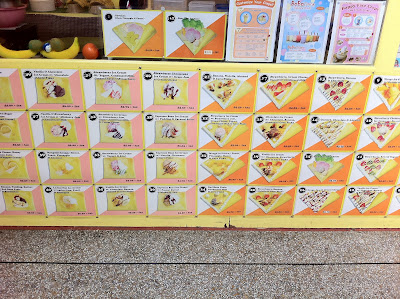 One thing I learned in San Francisco was that if you are a Japanese food lover but don't have the money to travel all the way to Japan, San Francisco is definitely your best option. Originally invented by French, crepes reached its popularity in Asia after transformed by Japanese. Belly Good Cafe & Crepes is located in Japan town, just 10 minutes away from the Union Square of downtown SF. A Japanese couple owns and runs this little, warm, and famous crepes shop. They have every combination of crepes that one can think of, but if you feel like being creative and adventurous, you can always create your own crepes.
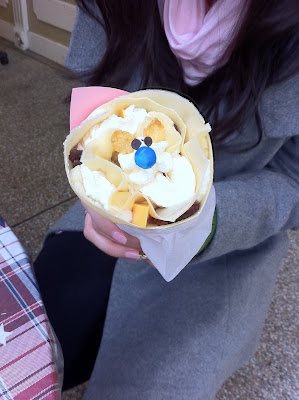 "Happy Face Crepes" is why Belly Good is so popular, aside from the fact that it tastes very good. People always say Japanese people are good at making cute stuff, but I was still very surprised when the chef gave me my No.48 Happy Face Crepe with pudding, whip cream, corn chips, red bean paste, and banana. Look at this crepe, how can you not want to come back for more?


 The name says it all: You must get a bubble tea when you come here. Unlike many bubble tea places in the mid-west, Verde is actually owned by Taiwanese people, and their bubble tea comes with all sorts of things that can only be found in Taiwan (Not even in China or Hong Kong, trust me!). I always get the regular milk-tea with tapioca just to test the water, but later I found out the one my friend had, milk-tea with noodle, was amazingly good. Never thought that noodle and milk-tea could go together? Try it in Verde and you'll fall in love with it.
 In addition to bubble tea, they also serve Taiwanese snacks. I ordered some Taiwanese style think toasts to see if Verde was good enough to have a place on my blog, and~ here it is! They come in all kinds of flavor, sweet or salty, and with a little extra money, you can have two flavors in one thick toast just to see which one you like better.
 Famous for its traditional Taiwanese food, Mama Chen is always in its full capacity, even on weekdays. Having their store name and menu written in Chinese, I was not surprised to find out this was the place full of Asians, or some Americans taken by their Asian friends. You can find almost every traditional Taiwanese dish in here, from stinky tofu to intestine noodle. However, just when you assumed that they also served bubble tea here, they would tell you they have everything except for bubble tea. If you feel like having a sweet ending after meal, go to Verde.
 Taiwanese oyster pancake is one of my favorite dishes of all time. Many tourists who come to Taiwan have it in Taipei, but the best oyster pancake is actually in my hometown, Hsinchu. To my surprise, the oyster pancake in Mama Chen was actually comparable to those in Hsinchu. What does that mean? The oyster pancake in Mama Chen is 4.5 star if Hsinchu oyster pancakes are rated as 5-star.
 Another thing I learned in SF was that there's not really a Chinatown or Vietnamese town where you find legit Asian foods that can't be found anywhere else. Because of the large Asian population in SF, not only did I hear people talking in Mandarin on the streets but also found Asian restaurants outside of the so-called Chinatown amazingly good.
 Due to the convenient location of being in the coast area, the seafood in Kappo Nami Nami is very fresh. The special dishes that Japanese restaurants have in the mid-west are their regular dishes in not only Kappo Nami Nami but also all Japanese restaurants in SF.
 In addition to raw fish and seafood, Kappo Nami Nami has traditional Japanese hot plates and bowls as well. Their portion comes a little smaller than the usual portion in mid-west, but the quality of food is incomparable.


 Being in the coast, eating raw and fresh seafood is a must-do to me. I"m not a big fan of eating raw seafood because I was food-poisoned before, but these middle-sized raw oysters did not disappoint me.


 --------------------------------------------------------------------------------------------
Belly Good Cafe & Crepes
 One thing I learned in San Francisco was that if you are a Japanese food lover but don't have the money to travel all the way to Japan, San Francisco is definitely your best option. Originally invented by French, crepes reached its popularity in Asia after transformed by Japanese. Belly Good Cafe & Crepes is located in Japan town, just 10 minutes away from the Union Square of downtown SF. A Japanese couple owns and runs this little, warm, and famous crepes shop. They have every combination of crepes that one can think of, but if you feel like being creative and adventurous, you can always create your own crepes.
 "Happy Face Crepes" is why Belly Good is so popular, aside from the fact that it tastes very good. People always say Japanese people are good at making cute stuff, but I was still very surprised when the chef gave me my No.48 Happy Face Crepe with pudding, whip cream, corn chips, red bean paste, and banana. Look at this crepe, how can you not want to come back for more?
Realizing their customers have different preferences, Belly Good serves their crepes in two ways: You can have it wrapped and ready to go, or you can go with the traditional French style, on the plate.
Belly Good address: 1737 Post St. #393, San Francisco, CA 94115
Note: Cash only. They don't accept credit cards.
---------------------------------------------------------------------------------------------
Verde Tea House

Verde Tea House is a chain tea house in SF, and apparently very popular among not only Asians but also every race in general. The layout of every store is slightly different, but the bubble tea is consistently in high standard.
 The name says it all: You must get a bubble tea when you come here. Unlike many bubble tea places in the mid-west, Verde is actually owned by Taiwanese people, and their bubble tea comes with all sorts of things that can only be found in Taiwan (Not even in China or Hong Kong, trust me!). I always get the regular milk-tea with tapioca just to test the water, but later I found out the one my friend had, milk-tea with noodle, was amazingly good. Never thought that noodle and milk-tea could go together? Try it in Verde and you'll fall in love with it.
 In addition to bubble tea, they also serve Taiwanese snacks. I ordered some Taiwanese style think toasts to see if Verde was good enough to have a place on my blog, and~ here it is! They come in all kinds of flavor, sweet or salty, and with a little extra money, you can have two flavors in one thick toast just to see which one you like better.
Verde address: 852 Villa St. Mountain View, CA 94041
--------------------------------------------------------------------------------------------
Mama Chen
 Famous for its traditional Taiwanese food, Mama Chen is always in its full capacity, even on weekdays. Having their store name and menu written in Chinese, I was not surprised to find out this was the place full of Asians, or some Americans taken by their Asian friends. You can find almost every traditional Taiwanese dish in here, from stinky tofu to intestine noodle. However, just when you assumed that they also served bubble tea here, they would tell you they have everything except for bubble tea. If you feel like having a sweet ending after meal, go to Verde.
 Taiwanese oyster pancake is one of my favorite dishes of all time. Many tourists who come to Taiwan have it in Taipei, but the best oyster pancake is actually in my hometown, Hsinchu. To my surprise, the oyster pancake in Mama Chen was actually comparable to those in Hsinchu. What does that mean? The oyster pancake in Mama Chen is 4.5 star if Hsinchu oyster pancakes are rated as 5-star.
Mama Chen address: 5075 Stevens Creek Blvd, Ste 10, Santa Clara, CA 95051
-------------------------------------------------------------------------------------------
Kappo Nami Nami
 Another thing I learned in SF was that there's not really a Chinatown or Vietnamese town where you find legit Asian foods that can't be found anywhere else. Because of the large Asian population in SF, not only did I hear people talking in Mandarin on the streets but also found Asian restaurants outside of the so-called Chinatown amazingly good.
 Due to the convenient location of being in the coast area, the seafood in Kappo Nami Nami is very fresh. The special dishes that Japanese restaurants have in the mid-west are their regular dishes in not only Kappo Nami Nami but also all Japanese restaurants in SF.
 In addition to raw fish and seafood, Kappo Nami Nami has traditional Japanese hot plates and bowls as well. Their portion comes a little smaller than the usual portion in mid-west, but the quality of food is incomparable.
Kappo Nami Nami address: 240 Castro St., Mountain View, CA 94041
------------------------------------------------------------------------------------------
Pier Market Seafood Restaurant

Located in Pier 39 of Fisherman's Wharf, Pier Market Seafood Restaurant serves the best seafood dishes I had in San Francisco.

Their clam chowder in bread bowl is one of my favorite dishes. Different from other clam chowders, the clam chowder they serve comes with real and fresh clams. A lot of Yelp reviewers said their bread bowls were very good too, but I was too full to finish the bread bowl as well.
 Being in the coast, eating raw and fresh seafood is a must-do to me. I"m not a big fan of eating raw seafood because I was food-poisoned before, but these middle-sized raw oysters did not disappoint me.
 Pier Market address: Pier 39, San Francisco, CA 94113
-------------------------------------------------------------------------------------------
Shabuway

Shabuway is a Japanese Shabu-Shabu place. For those of you who are not familiar with Japanese dining, Shabu-Shabu is similar to Chinese style hotpot, but in a healthier style because you don't drink the soup. Different from the regular hotpot, you don't leave the meat in the soup. You only dip the meat into the soup a few times so the Kobe beef would not get "old" and lose the purpose of ordering such high quality meat.
There's only two soup bases available in Shabuway: Seaweed soup and spicy soup. Interestingly enough, there's only one meat available: Kobe beef! However, you do have a choice between a regular portion or super large quantity of Kobe beef.

Once you choose your soup bases and how much meat you want to eat, it's time to enjoy. Veggies come with the Kobe beef combo, and it's highly recommended that you put the veggies in first because the longer you cook the Napa veggie, the better it'll become.
In such a great place for Shabu-Shabu and Kobe beef, I only have one suggestion for those of you who are thinking about going: Just close your eyes and eat as much as you want because you don't get this kind of meal everyday. God will forgive you for forgetting about the diet you're going though.
Shabuway address: 180 Castro St. Mountain View, CA 94041
Thursday, March 10, 2011
Wednesday, March 9, 2011
Subscribe to:
Posts (Atom)